Myra Hess: National Treasure
News Story
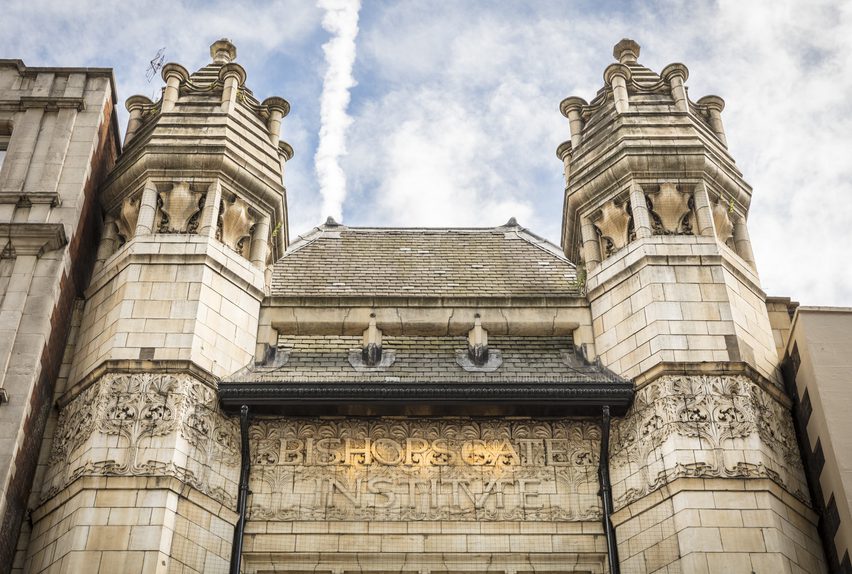
On May 11, 2025, we celebrated Myra Hess, whose 1927 Rosewood Model D Steinway Grand piano has been Piano in Residence at Bishopsgate Institute since 1965.
Click here to view more on Bishopsgate Institute's connection to Myra Hess.
Videography: Bartek Podkowa | Seven Hills Films
During the event, Jessica Duchen, author of Myra Hess: National Treasure, joined Nigel Hess, Myra’s Great Nephew and Stephen Kovacevich, a student of Myra, to reflect on her life and legacy.
Where the Project Began
Nigel: You came up with this crazy idea of writing a new biography of my great Aunt Myra Hess, because there hadn't been one for nearly 50 years
Jessica: Yes... a book called Myra Hess A Portrait. It was published in 1976, and there are copies of it floating around second-hand, but it's been out of print for a very long time.
And I think what alerted me to the fact that we needed a new one is that I'd been doing a lot of work on Jelly d'Arányi, the violinist, for another book and she and Myra had worked together very, very closely for more than 20 years, and she didn't get more than a footnote in that first book. So, I thought there's going to be a lot missing.
Nigel: Where did your passion for Myra come from? Why did you want to write this book?
Jessica: It started really when I was a small kid because my mother's name was Myra and she was a big piano fan, and we lived in Hampstead. So we used to go for walks on the Hampstead Heath extension opposite which Myra herself had lived for quite a long time, certainly during World War 2, and there was a blue plaque on her house. So, my mother, Myra, always wanted to park outside Myra Hess's house.
Then I studied piano myself, and I used to listen to her recordings, and I was absolutely enchanted by them. I had a real penchant for historical recordings, but somehow, she was the one who always spoke to me the most strongly, and it kind of sprang from that.
Studying with Myra
Nigel: Stephen, you've written a wonderful preface to the book, absolutely fascinating, and in it you say that you came to Britain in 1958 to study with Myra. Why?
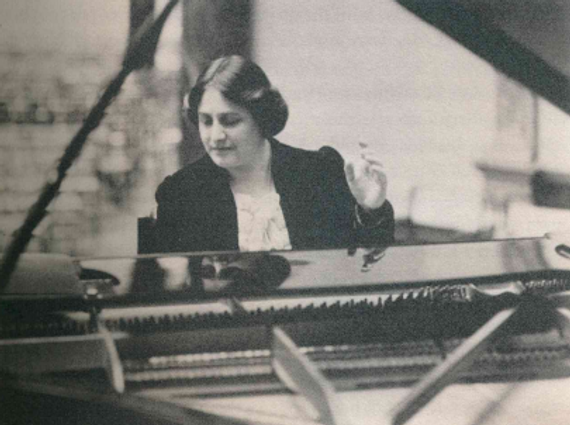
Myra at the piano
Stephen: The Griller string quartet... was in residence at the University of California, and... Sidney Griller introduced me to Myra Hess and... I really wanted to work with her...
I played for her and she accepted me as a student, and I had the choice of going to Juilliard or Myra and thank goodness I chose Myra because it was the repertoire that interested me... we all know she was a great artist, and she was a great teacher.
Strength and Spirit
Nigel: And when you were working on the book, Jessica, how did that side of Myra evolve? How did her personality evolve as you did the research? Was she what you were expecting or were there surprises?
Jessica: She was what I was expecting only about 100 times more so....
There was a wonderful description I came across by Gerald Moore, the great leader pianist. He was making a speech about her shortly after World War 2 and... after she had run the National Gallery concerts in Trafalgar Square, he said, people always think there are 4 lions in Trafalgar Square, the Landseer bronzes under Nelson's column, but actually there were five, and Myra was the 5th Lion, and she really was.
I think... she kind of had to become tough... living through two world wars and dealing with the kind of things she had to deal with on the daily, hourly, weekly, yearly everything basis, by the end of her life, she was, I think, so indomitable that even her close friends didn't really dare to stand up to her.
Nigel: And of course...the other side of Myra was the wicked sense of humour wasn’t it… It's worth getting Jessica's book just for all the anecdotes. They're absolutely, absolutely wonderful... I remembered going to her house in St. John's Wood.
I remember two things about that visit. One was that because it was so close to the cricket ground, she told me that she enjoyed hearing the applause at the end of each over because it reminded her of the applause that she used to get in her concerts... And then, as we were leaving... I happened to notice, the shape of the back lawn of the house, which was the shape of the Grand Piano, and she didn't mention it to anybody, but if you noticed it, you noticed it...
And you include quite a few sort of anecdotes like that in the book... the one lovely story, of course we can tell, is the soldier on the train, isn't it?
Jessica: Yes, there was a there was a young soldier on a on a train who was Whistling Jesu Joy, and I think there was a journalist who was sitting opposite him and said to him, oh, do you do you like Bach then and the soldier said that's not Bach, that's Myra Hess.
Audiences and the American Steinway
Stephen: In this country she didn't play with quite the fire that she did in America... she adored the American style because it was raucous, and it released something in her, and she did play differently... I also think the English treated her with the kind of reverence which was slightly killing rather than stimulating.
Nigel: Yes, they treated her a bit like the Queen Mother, didn’t they
Jessica: Yeah, I think there's a level of open adulation that American audiences perhaps gave her that was much less restrained than the terribly decorous English audiences and maybe she was also responding to that. Do you? Do you think that's possible?
Stephen: Yes, and let's not forget the American Steinway.
Nigel: Why do you think they (Steinway pianos) were so different, why did Maya respond to them so well?
Stephen: The American action tended to be quicker. And the sound was enormous, and the European pianos are magnificent, but they're different. They're quite different... It's like the leash was taken off and she could run around.
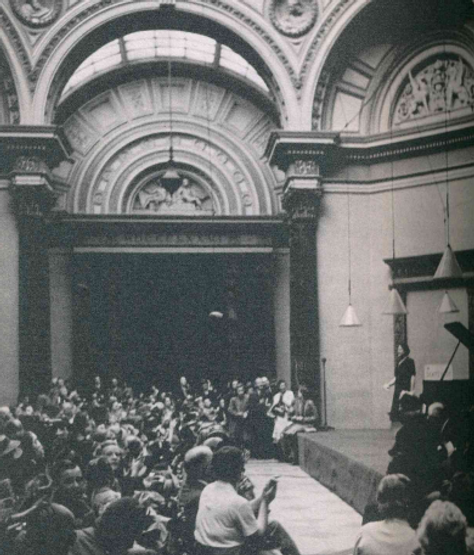
Myra performs at the National Gallery
Faith and Identity
Nigel: Her Jewishness remained very important to her for the whole of her life... she was brought up as an Orthodox Jew as a child... it was it was in the background all the time, wasn’t it?
Jessica: Yeah, I think she never lost sight of it. She once said in in an interview that her Orthodox upbringing was the making of her. I have a theory that's to do with self-discipline and that you need the same kind of self-discipline for keeping up a strict religious Practise that you need for a strict musical Practise. You know you can never really let it slip.
I think to maintain Orthodox Judaism as a performing artist, is very difficult because you can't really stop. You're travelling and you're practising and such like, every Friday night for 24 hours. But I think that, although she did develop quite an interest in Christianity in certain ways as time went by, she never, ever, wanted to leave her inherited faith behind.
Myra's Kindertransport Connection
Nigel: So, after the war, she then went to America to play. But what your book has uncovered... was... the non-musical thing she did during the war itself. And I'm thinking in particular of the connection she had with the Kindertransport, to which she and Vaughan Williams donated considerable funds together, didn't they...
Jessica and I did a talk as part of the Jewish Book Week this year at King's Place, and I threw the talk open towards the end to a Q&A, and you have to tell everybody about the first person that stood up and asked a question.
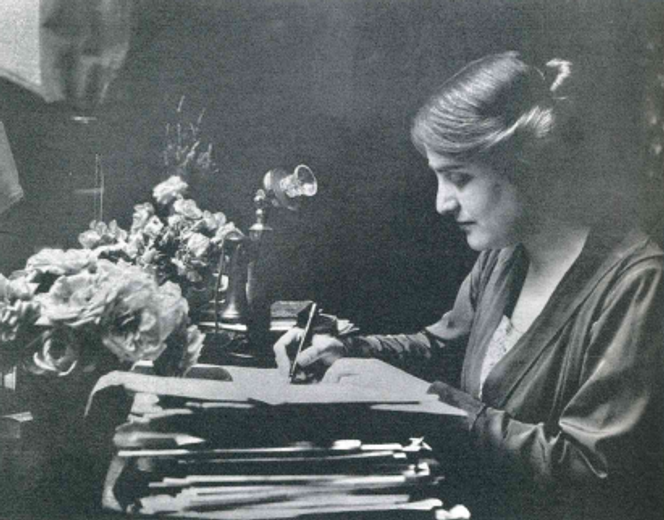
Myra Hess at her desk
Jessica: He was a gentleman who had come along with his whole family and he said that his mother had been one of the two sisters that Myra had sponsored on the Kindertransport. All the children who were being brought over on the Kindertransport had to have a sponsor who would put up £50 for their expenses in Britain, and £50 was... a significant sum at the time.
And Myra had sponsored these two girls, called Josephine and Ella Eberstark, and this was Josephine's son, who had turned up, and he said his mother lived to be 99 and that she and he and their whole family felt that they owed their lives to Myra Hess. And there were tears that night, not least from us.
A Lasting Impression
Nigel: So just to finish, Stephen... a difficult question to answer, but your abiding memory of Myra and working with her all those years.
Stephen: Her devotion to music. It was a passion which you don't see that often, but you can hear it in the way she taught and the way she searched for things in the music, you could call it a spiritual journey or introspective journey, but all of her was involved in it and she wasn't pompous, but she was dedicated. It was, I suppose, it's sort of vocation.